

HTML, CSS, and JavaScript, are the web development standards required for building the user interface and core application logic. TypeScript is the superset of JavaScript that adds static typing, which can make large-scale applications easier to manage. Node.js is the knowledge of this server-side JavaScript runtime, helpful for setting up the development environment, managing dependencies via npm, and potentially building backend services. Popular frameworks (Flutter, React Native, Ionic, .NET Multi-platform App UI (MAUI))
How to implement these technologies for hybrid app development?
- Effective implementation requires a structured process and a focus on best practices to overcome common hybrid app challenges.
- Create wireframes and prototypes, considering a responsive UI that works across various screen sizes (Plan and design)
- Choose the right framework.
- Minimize reliance on the WebView for better optimization.
- For features requiring high performance use native modules or plugins (Integrate native features)
- Design for platform-specific UI conventions (use Material Design for Android). Ensure a consistent UI and UX.
- Follow secure coding practices by using HTTPS for API calls and encrypting sensitive data, security patches for frameworks and plugins
If cross-platform frameworks now offer near-native performance, cost savings, and broader reach, should we assume they are always the smarter choice?
Flutter and React Native compile into native code and give developers access to native features like GPS, camera, and notifications. So then, why not abandon native development entirely?
Security is another concern. Frameworks built on web tech can be vulnerable to cross-site scripting and other internet-based attacks.
Then there’s debugging. When a bug lies somewhere between your code and a native layer you can’t fully see or control, how much extra time is lost? Would that same issue be easier to fix in a native environment?
And what happens when a platform like iOS rolls out a new feature? Cross-platform frameworks often lag in supporting the latest APIs. Are we willing to delay product innovation because a plugin hasn’t caught up?
Cross-platform tools solve many problems. But blindly following trends without asking what is lost in the trade-off leads to poor decisions. The right question is not “Can we use one codebase for all?” but “Should we—for this app, this audience, and this goal?”
What Exactly Affects The Cost?
Let’s play a game. Just give me 15 minutes. Trust me, it’s going to be fun. So imagine you have $1,80,000 (or maybe $1,50,000) for mobile app development. Pre-development and design costs, Technical and framework costs, Quality and security costs, and Post-launch and operational costs are other types of costs involved in developing a cross platform app. Some things that flare up the overall app development cost:
- App Complexity: In-app payments, geolocation, AR, AI, video chat
- Screen Count: More screens = more UI logic = higher dev time.
- Team Location: U.S. developers charge $100–$200/hour. Eastern Europe or India? Closer to $25–$70/hour.
- Third-Party Stuff: Payment gateways, Firebase, Google Maps? All add cost.
- Maintenance: Budget 15–30% of initial cost annually for updates, bug fixes, and scaling.
Does Cross-Platform Development Save Money, Slack?
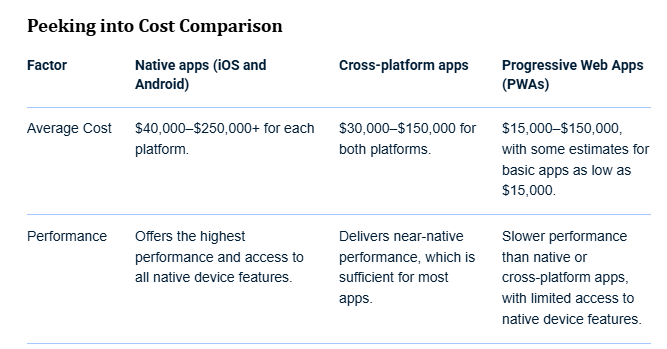
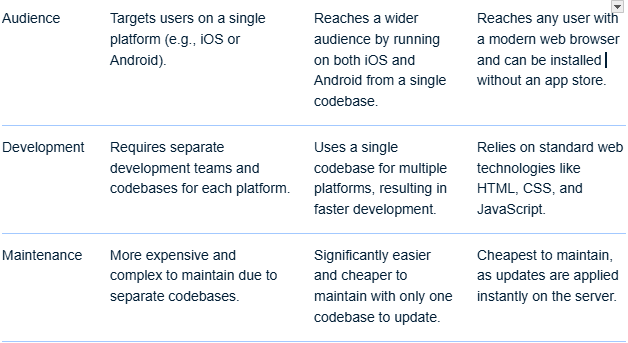
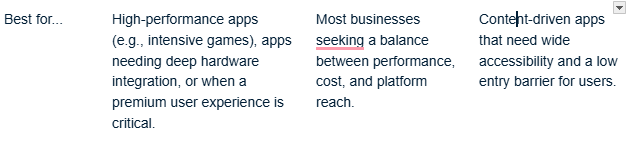
If done right, it will. Native iOS + Android separately? Expect to pay $100K–$300K+. One solid cross-platform app? You can usually get away with $30K–$150K. PWA? Cheapest. But with trade-offs. Also, maintaining two native codebases is a budget-killer. Cross-platform gives you one codebase to test, fix, and update. Here’s where Cross-platform App Development services prove their worth: Faster time to market, Lower dev and maintenance costs, Wider audience, and Simpler updates.
Trending Technologies and What They Might Cost You
Have you ever wondered why app development seems to cost so much? Or why some tech choices are more popular than others, even if they’re not the flashiest?
Let’s start with Flutter. It’s all over the place right now, and people say it’s here to stay. But what makes it so lasting? Is it the fact that it lets you build for both Android and iOS from one codebase? Probably. Still, even a simple Flutter app can set you back around $5,000 to $20,000. Want something more advanced? You could easily be looking at $40,000, or even more than $100,000.
Then there’s React Native. It’s another big name. Some developers swear by it. But does it really cost less than Flutter? Surprisingly, not really. You might pay $10,000 for a basic app, but if your app involves complex features or fancy designs, the cost can go past $150,000.
Progressive Web Apps (PWAs) also caught my eye. They don’t need separate versions for Android and iOS, which sounds great in theory. But even then, the price can range from $15,000 to $40,000. So even though they seem “simpler,” you’re still investing quite a bit.
And finally, Ionic. It’s built with web tech and can be wrapped in a native shell. Super accessible, especially for smaller projects or student developers. I found out it’s one of the cheapest options, with basic apps starting around $3,000 and maybe going up to $15,000. But here’s the catch performance might suffer compared to native builds.
After looking into all this, I didn’t walk away with one “right” answer. But I did come away with better questions like what’s more important for your project: speed, quality, long-term scalability, or initial cost?
So, what should be your budget in 2026?
Use this rough guide (these costs are not fixed, and may vary owing to several features, need of the client, need of the project, demand in market, need of the organization to scale, or cut down costs, availability of developers, technologies they wish to use, skills they are adept in)
- Basic App: $20K–$40K
- Mid-range App: $40K–$100K
- Complex App: $100K–$500K
How much will a progressive web app cost? Around $5K–$150K, depending on scope. Want a tip? Always start with an MVP. Keep it extremely easy to read and simple with just basic features. Test the market volatility. Then invest more once you’re sure it’s working. (All figures are in US dollars)
Why Does It Pays to Be Honest About Budget Early?
If your max budget is $50K, don’t pretend it’s $150K. Be upfront. A good developer or agency will guide you to the best solution within your limit. They’ll help prioritize features, select the right stack, and keep things realistic. I’ve seen too many projects stall because people didn’t set expectations.
Conclusive
I have tried covering cost factors, features, technology stack, benefits of cross-platform app development, with an overview of how to reduce this type of cost, and potential challenges and bottlenecks. This was a brief illustration of how it works. To have a more realistic look, reach out to our support team.
