Why is Enterprise AI still important when several alternatives, better in performance and stability are available. Check out Google Cloud (Vertex AI), Microsoft Azure AI, and AWS SageMaker, as well as specialized platforms from companies like IBM (watsonx), DataRobot, and H2O.ai, conversational AI (e.g., Kore.ai, Yellow.ai) or enterprise search (e.g., Glean, Lucidworks Fusion), Langflow or n8n. A retail company uses AI to predict which new clothing styles will be popular next season, reducing waste and increasing sales.
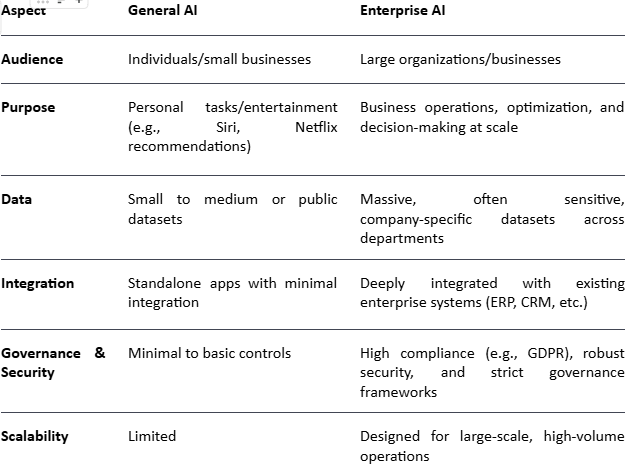
Applied AI, Industry AI, Business AI, and Organizational AI are some of the adjectives that define Enterprise AI. It is not just a simple AI used in large organizations; it is a specialized application of advanced AI technologies designed to solve complex, mission-critical business problems. It is fundamentally different from general or consumer AI due to its emphasis on integration, security, governance, and delivering measurable business outcomes across an entire organization.
Key Distinctions from General/Consumer AI
Use Cases and Examples
- Companies use AI chatbots to answer simple, frequently asked questions (“What are your store hours?” or “How do I reset my password?”) 24/7, which reduces the need for human agents for basic queries.
- A retail company uses AI to analyze past sales data (seasonality, promotions, weather) to predict which products will sell best next month and ensure stores are adequately stocked.
- A telecom provider uses AI to analyze customer usage patterns and service calls to identify customers most likely to cancel their service, allowing them to offer targeted retention deals.
- AI is being used to calculate the most fuel-efficient delivery routes for all its drivers each morning, saving time and reducing fuel costs.
- Fraud detection systems, personalized recommendation in ecommerce apps, and credit risk assessment models are some other examples of systems working on AI.
Why Now Becomes the Wise Moment
Once a finance lead sighed over a pile of reconciliation tasks. We plugged in a small internal model from one of the trusted AI development companies. Two weeks later her team was doing higher value work instead of wrestling with spreadsheets. That moment stuck with me. It made the shift feel real, not theoretical.
What If The Work Could Carry Some Of Its Own Weight
AI development services now feel mature enough for long term adoption. Models can sort customer issues, forecast demand, clean data streams, or catch anomalies before they turn into outages. I had a supply chain client who used an early model from an AI app development company to tag mislabeled inventory. They told me the model saved them more hours in one month than their old process did all year. That kind of shift teaches you fast.
Where Trust Begins To Matter More Than Hype
The good AI development companies do not just sell models. They guide teams through the messy parts. One of my favorite wins was watching a tired operations manager breathe out when she realized her new AI assistant would not bulldoze her workflow.
Why The Benefits Stack Up Faster Than Expected
You get faster decisions. Cleaner data. Fewer manual errors. More predictable planning. Teams stop drowning in low value tasks. Leaders see patterns sooner. Customers get answers quicker. None of this feels magical. It feels like the office finally got power steering. Enterprise AI frees attention for strategy instead of survival.
What This Means For Anyone Still Debating
If a company waits too long, competitors will pass them quietly. The firms moving now are doing it with small, smart steps. A pilot model in one workflow. Then a service linked to an internal platform. Then a full Enterprise AI stack once the value becomes obvious. The path is practical and available.
Why does the Middle East region lean into Enterprise AI now?
The UAE market treats Enterprise AI as a practical tool rather than a buzzword. Energy, logistics, tourism, finance, and public services all push for tighter efficiency and more predictable outcomes. Most teams I meet want AI that plugs into what they already run. They look for models that sit cleanly inside ERP and CRM suites and behave well around rules on data residency, uptime, and security.
Enterprise AI fits that need because it can monitor streams, classify events, route actions, and support mission-critical loads without breaking existing architectures. I have seen firms take a legacy workflow that once required long manual checks and move it to a setup that flags issues in real time through an internal model trained on their own telemetry.
What pushes adoption across core industries?
Energy operators use Enterprise AI to track grid performance and call out maintenance windows before a failure hits productivity. Cargo and logistics groups apply models to routing and fleet scheduling so they can cut fuel overhead and steady delivery patterns. Tourism and service providers use generative tools to shape tailored content for travelers inside CRM flows.
These tools sit on top of structured data pipelines and give staff cleaner insights with far less manual curation. Customer service centers rely on triage models that resolve simple requests quickly and hand off the harder ones to people with the right context. Security teams use anomaly detection models that learn patterns from operational data and help catch abnormal behavior earlier.
How does policy set the pace?
The national AI Strategy 2031 keeps pressure on agencies to adopt systems that raise service quality and operational resilience. This top-down clarity encourages private firms to invest early. The projection that AI could add more than 135 billion USD to the economy by 2030 has become a planning anchor for many executives. They treat it as a signal that infrastructure and talent pipelines will keep improving.
Where does infrastructure meet compliance?
Companies building Enterprise AI solutions in the UAE rely on modern cloud layers, high performance compute clusters, and strong local hosting options. Many teams choose Azure UAE Central or similar sites so they stay aligned with data residency laws. This reduces the friction between innovation and compliance. Model training often runs on scalable GPU or TPU pools, and firms set up fine tuned generative models that can read domain specific documents while respecting internal access rules. Observability stacks track latency, drift, and throughput so that AI workloads meet the same reliability bar as other enterprise systems.
Why the region is moving fast now
The Middle East aims for long term economic strength, and Enterprise AI fits that ambition. It automates routine work, keeps processes steady across departments, and gives leaders the kind of operational clarity older systems never quite delivered. As generative models mature, AI handles complex document creation, content tagging, and predictive planning across connected platforms.
Everything moves with less friction and fewer surprises. Teams trust their data more and spend less time patching gaps. AI App Development Companies like Konstant Infosolutions, already rooted in Abu Dhabi, Dubai, and Saudi Arabia, work with these Enterprise AI patterns every day. They are well-suited for modern application builds and help local firms move from cautious pilots to dependable, production-grade systems.
Conclusion
Using Artificial Intelligence across a large company is essential for success, not just a temporary fad. It’s a critical, necessary action for the company’s long-term plan, not an optional experiment. The unique benefits (like speed or lower costs) that let one business outperform rivals.
Applying AI technologies, like machine learning or data analytics, across an entire organization’s operations and departments. The specific tasks, processes, and computations that a large business runs daily (e.g., managing supply chains, analyzing sales data). Implementing AI fairly and securely, considering potential biases and ensuring data privacy.